CHEK JAWA REVISITED(published in Naturewatch magazine)
Some schools took the opportunity to send their students to CJ for the interactive outdoor classroom experience. Undergraduates from NUS also spent time learning about the biodiversity of the site with “live”samples. To study the effect of human activity on carpet anemones, researchers could not have chosen a better site in CJ for these anemones are widely scattered over the sandflats and are often trampled upon.
|
And in the race against the changing tides, documentation is often adrenaline–charged and frenzied. For I have tuned my mindset to expect the unexpected. And invariably something new does crop up – like the endangered Bailer snail, the Sea Robin, Moray Eel, spider crabs and an aquatic File snake. It is comforting to know that more lies hidden in the sand and mud. And nocturnal visits are a revelation, for many organisms seek the security of darkness to predate or feed. Under the glare of the torch-lights, the long, groping tentacles of Brittle Stars are rapidly retracted into the crevices. To see the huge Noble Volute laying egg capsules, the octopus walking on land, the cuttlefish changing its colours, the tiny porcelain crabs peeping out of the secondary polyps of the Sea Pens, the erratic jump of the Gong Gong snail, the rapid intrusion of tubeworms and the Sea Apple ejecting water spontaneously – one can not help but reflect on the miracle of life. I was surprised to note that there might be a seasonal explanation to some of the organisms found on CJ. At certain times some nudibranchs were seen in numbers and at other times – none at all. The profusion of quilt pen-like feathery Sea Pens near the muddier areas was a highlight one morning. The sudden disappearance of some of flora and fauna had me wondering whether there was indeed a result of the impact of visitors stomping at CJ instead of the seasonal nature. It was disturbing news when slash wounds were noticed on Priscilla’s rear end (The New Paper June 9 2003). For those who had the chance to view this docile mammal (she was brought up by residents of CJ but was released when the residents had to leave) the act was one of contempt. To see the long stretches of drift-nets and fish cages placed with impunity at CJ, one can not help but wonder whether all the efforts at conservation had been in vain. There is also a downside when visitors trample all over the site. Some carpet anemones along the guiding routes have already disappeared. The colourful sponges that were once widely scattered at the coral rubble area had also disappeared. Low tides below 0.5m at CJ are far too few in between and hopefully there might be a chance of recovery during the other times. Revealed here are some of the creatures that were lesser seen and some are rare and endangered and each have a story to tell. I hope these images will provide the visitors the opportunity to see beyond the guided walks. The discovery of CJ has also made Singaporeans realize that there is more than meets the eye. Little pockets of nature, if retained, can stimulate understanding and respect for life and evoke emotions of bonding with the country. Visit Chek Jawa if you have not already done so. Each visit is an occasion to celebrate the spectacle and miracle of life.
adapted from Nature Watch Vol 11 No. 4 October - December 2003 |
Text & Images by Chua Ee Kiam |
|
all rights reserved
|
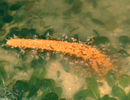 Above
and below: Flowery sea pens (Cavernularia sp.)
Above
and below: Flowery sea pens (Cavernularia sp.) 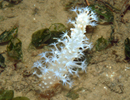 Flower-like secondary polyps emerge at night
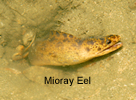 Moray
Eel (Gymnothorax sp.). Most unusual to be seen at low tide
at CJ
Moray
Eel (Gymnothorax sp.). Most unusual to be seen at low tide
at CJ 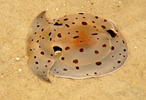 The
only member (Euselenops luniceps) in the genus, this sea slug
is capable of swimming reasonable distances.
The
only member (Euselenops luniceps) in the genus, this sea slug
is capable of swimming reasonable distances.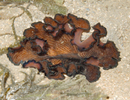 Marine
flatworm (Pseudobiceros fulgor)
Marine
flatworm (Pseudobiceros fulgor)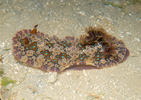 Blue-spotted
nudibranch (Dendrodoris denisoni)
Blue-spotted
nudibranch (Dendrodoris denisoni)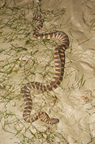 The
Banded File Snake (Acrochordus granulatus) lives in shallow
seas, estuaries and mangroves. Although reported to be fairly
common, the snake is not easily seen as it is nocturnal.
The
Banded File Snake (Acrochordus granulatus) lives in shallow
seas, estuaries and mangroves. Although reported to be fairly
common, the snake is not easily seen as it is nocturnal.